 UK
UK  EN
EN  RU
RU 

Residence Card With a Criminal Record
The issue of legalization in Poland for foreigners with a criminal record causes the greatest fear and gives rise to many myths. People often say that even a minor violation of the law in the past automatically closes the path to obtaining a residence card. In reality, Polish immigration practice is much more complex — and not nearly as straightforward.
A residence card with a criminal record is possible, but only with a proper risk assessment and a well-structured strategy. In this article, we will explain how Polish authorities actually approach such cases, what exactly the voivode checks, and which factors may play a decisive role.
We Will Help You Assess the Risks and Prepare a Safe Strategy

What Is a Residence Card and Why Does a Criminal Record Matter
A residence card is an administrative decision that gives a foreigner the right to stay legally in Poland for a specific period and, in most cases, also to work, run a business, or study.
Depending on the basis, a residence card may be:
- temporary — on the basis of work, business, studies, or family circumstances;
- permanent — on the basis of long-term residence, Polish origin, or marriage to a Polish citizen;
- a long-term EU resident card — for people who are stably integrated into Polish society.
For the immigration office, the key issue is not the fact of a past criminal record itself, but the question: does the applicant pose a threat to public order and state security. The entire review process is built around this criterion.
How Polish Authorities Assess a Criminal Record When Applying for a Residence Card
The voivode does not make decisions automatically. Each case is assessed individually, taking into account a number of circumstances that may either reduce or increase the risk of refusal.
The Nature and Severity of the Offense
The greatest attention is given to crimes involving violence, drugs, serious financial damage, or offenses against life and health. Such cases may be regarded as a potential threat to society.
At the same time, administrative or less serious offenses, especially those that happened a long time ago, do not always carry decisive weight.
How Long Ago the Incident Happened
Time matters a great deal. If several years have passed since the offense and the applicant demonstrates stable and law-abiding behavior, this significantly reduces the negative impact of the criminal record.
Where the Criminal Record Was Obtained
Offenses committed outside Poland are also checked. However, the authorities assess whether the legal classification of the offense corresponds to Polish criminal law and whether it still has any current legal consequences.
Status of the Criminal Record
An expunged or cleared criminal record is an important argument in the applicant’s favor. It shows the absence of active restrictions and the end of the legal consequences of the case.
Level of Social and Economic Integration
Official employment, regular income, tax payments, a stable place of residence, studies, or professional development show that the foreigner is integrated into Polish society and does not create additional risks.

Can You Get a Residence Card With a Criminal Record
Polish law does not contain a direct ban on issuing residence cards to people with a criminal record. The decision is always made individually, taking into account all the circumstances of the specific case.
In Work Permit’s practice, there have been many cases where applicants with a criminal record successfully obtained a residence card thanks to a properly prepared document package and a clear position presented to the immigration office.
How to Increase Your Chances of Getting a Residence Card With a Criminal Record
1. Confirm That the Criminal Record Has Been Expunged or Closed
It is recommended to prepare official documents confirming that the criminal record has been expunged or is legally closed:
- a certificate from the court;
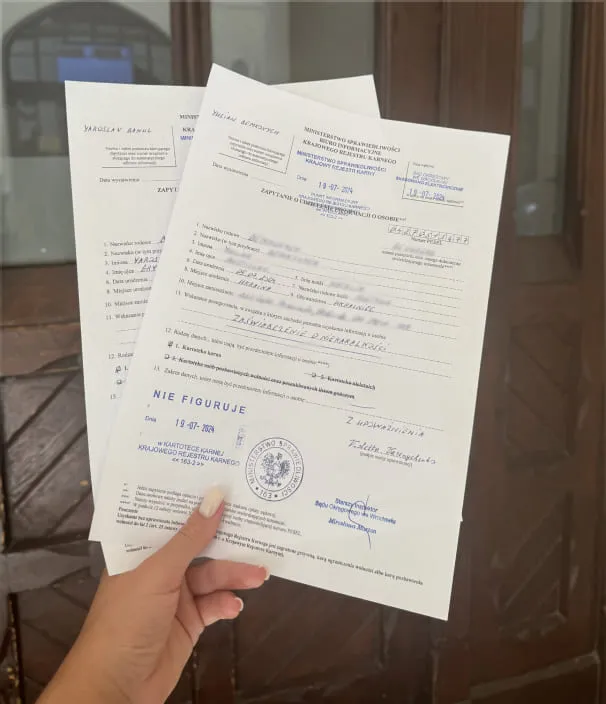
- an extract from the criminal record register;
- documents confirming the completion of the sentence or payment of fines.
2. Build a Strong Evidence Base
It is worth attaching documents to the application that demonstrate stability and responsibility:
- an employment contract or umowa zlecenia;
- certificates from the employer;
- proof of tax payments;
- certificates from educational institutions or course certificates;
- documents confirming volunteer activity.
3. Prepare an Explanatory Letter
An explanatory letter is an opportunity to show the human side of the case. It is important to describe the situation honestly, explain what conclusions were drawn, and emphasize the applicant’s current lawful and stable activities.
4. Do Not Hide Information
Trying to hide a criminal record or provide incomplete information almost always ends in a refusal. Transparency and openness significantly increase trust on the part of the authorities.
How the Procedure for Applying for a Residence Card Works if You Have a Criminal Record
Preparation of Documents
In addition to the standard package, documents related to the criminal record and materials confirming the applicant’s stability are prepared.
Submission of the Application
The application form must be completed correctly and without hiding any facts. All information is checked by the immigration office through state registers.
Review and Analysis
The voivodeship office conducts a review, sends requests to the relevant authorities, and assesses whether the applicant poses a risk to public order.
Decision-Making
If the decision is positive, the residence card is issued. In the event of a refusal, the law provides for the possibility of an appeal.
What to Do if You Receive a Refusal
A refusal is not the end of the process. The law provides several further options:
- filing an appeal with the Office for Foreigners (UDSC);
- supplementing the evidence base and reapplying;
- preparing objections with the support of an immigration lawyer;
- in exceptional cases — applying to the administrative court.
Residence Card With a Criminal Record — A Real Path to Legalization
Having a criminal record does not mean an automatic refusal. For Polish authorities, what matters most is the applicant’s current behavior, level of integration, and the absence of any threat to society.
A properly prepared strategy, a complete set of documents, and a professional approach significantly increase the chances of a positive decision.
If you want to objectively assess your chances and prepare your case without unnecessary risks, contact Work Permit through the website contacts or the consultation form. We will help you build the right legal position and support you throughout every stage of the process.
We Will Help You Prepare the Case Without Unnecessary Risks